University History
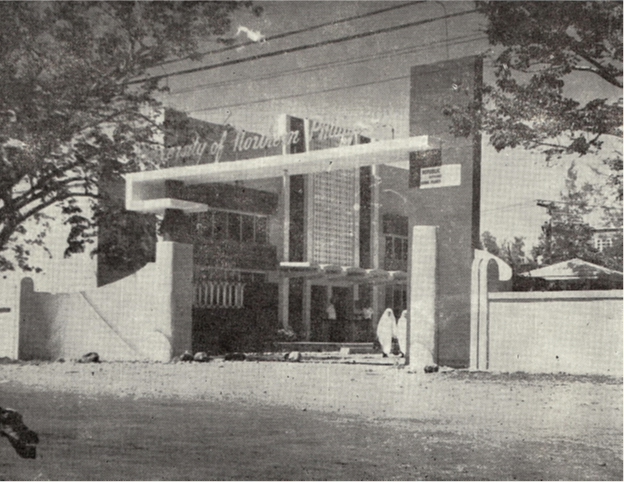
The University of Northern Philippines has its humble beginning as a shop department of the Old Vigan High School. Founded in 1906 and dedicated a year later, it started to play its vital role of training the youth in this part of the land for independent and democratic ways of life and to impress on the people, who were then still under the charm of Spanish aristocracy, the idea that the labor of the brawn is no less honorable than the labor of the brain – that the man who runs the machine is no less a child of God than the man who sits in the office.
In 1910, the Shop Department of the Vigan High School became a separate school of the intermediate level. It was then given the name Vigan Trade School. Seventeen years later, it embarked on a higher educational venture when it started offering its first secondary trade course. Twelve students were enrolled in the first year. Other course were offered later and in 1932, it made its first contribution of semi-skilled and skilled workers who were then (and even now) in great demand in a rapidly progressing nation. For the second time, the name of the school was changed to Ilocos Sur Trade School.
From 1927 to the years immediately after the Second World War, the school was supported by the provincial government. In 1951, by virtue of Republic Act No. 647, authored by Representative Floro S. Crisologo of the First District of Ilocos Sur, the Ilocos Sur Trade School was converted into a regional and national school of arts and trades known as the Northern Luzon School of Arts and Trades (NLSAT). It offered trade-technical courses above the secondary level to train the much-needed technical men who would transform into reality the dream of the government to achieve total economic and industrial development of the country. The school gave its first batch of graduate under the new trade-technical curriculum in 1956.
The rapid expansion of the courses offered in the school necessitated the acquisition of a new school site and the construction of a bigger building for the growing student population. Besides the trade courses for boys, trade courses for girls were added. Short unit courses were also given for those who needed only skills training. In 1955, the school transferred to its new and present site, a landscaped eight-hectare campus in Tamag, Vigan.
The name of the school was changed for the fourth time when, in 1960, under the General Appropriation Act, R.A. No. 2700, it became Ilocos Sur School of Arts and Trades.
In 1965, realizing the need of an institution for higher learning in this part of the country and the great amount of money spent each year to de-liver education in the municipality, Representative Floro S. Crisologo presented in Congress a bill which became R.A. No.4449 on June 19, 1965, converting the Ilocos Sur School of Arts and Trades into the University of Northern Philippines.
It is beyond one’s imagination to picture a school of arts and trades without a single college assuming the role of a university. But the University of Northern Philippines never faltered in moving forward, like the great strides it took in the past, though it took time to fill the great void. A period of adjustment was necessary.
On October 14, 1965, the Board of Regents was constituted. Dedicated leaders of the province were picked to compose the Board. Governor Carmeling Pichay Crisologo, known for her administrative and managerial abilities and for her sincere concern for the welfare of the University, Atty. Andres R. Asistin, Administrative Officer of the Bureau of Vocational Education and president of the UNP Alumni Association, and Mr. Pastor M. Obien (then Superintendent of the ISSAT) composed the Board. Mr. Obien was designated as Officer-In-Charge of the University and as such, became ipso facto chair of the Board. Mr. Bonifacio A. Rosales, Senior Executive Assistant II, was chosen the acting Secretary of the Board. In 1967, Atty. Eduardo Ma. Guirnalda, Provincial Board Secretary, became a member of the Board of Regents.
With vision projected towards the future and to the needs of the people of the North, the Board of Regents started shaping the path which the University will follow in its great educational venture. The College of Industrial Education was opened, then followed by the Liberal Arts offering courses in Pre-Engineering, Nursing, and Bachelor of Arts.
On August 18, 1966, the two-story Related Subjects Building, which housed the library and the Physics and Chemistry laboratories, was razed to the ground by a fire of unknown origin. But this did not hinder the educational activities of the University. Educational must go on and in due time, through the help of Congressman Floro S. Crisologo and Governor Carmeling Pichay Crisologo, the Board of Regents was able to find every means to replenish the books and equipment and provide the students with buildings.
As school year 1967-1968 ended, the University of Northern Philippines took pride in presenting its first contribution to the nation’s need for compe-tent industrial education teachers. The College of Industrial Education trium-phantly produced 34 graduates who eventually became Industrial Education teachers.
1967-1968 was just the beginning. The University of Northern Philippines, from a humble beginning, is expected to move on through the years bringing into fruitful reality the dream of Ilocos Sur’s greatest leaders today Congressman Floro S. Crisologo and Governor Carmeling Pichay Crisologo – to establish an institution of higher learning for the present and the future generation of the people of Ilocandia.
Reprinted from the UNP Annual, 1968
The University of Northern Philippines has its humble beginning as a shop department of the Old Vigan High School. Founded in 1906 and dedicated a year later, it started to play its vital role of training the youth in this part of the land for independent and democratic ways of life and to impress on the people, who were then still under the charm of Spanish aristocracy, the idea that the labor of the brawn is no less honorable than the labor of the brain – that the man who runs the machine is no less a child of God than the man who sits in the office.
In 1910, the Shop Department of the Vigan High School became a separate school of the intermediate level. It was then given the name Vigan Trade School. Seventeen years later, it embarked on a higher educational venture when it started offering its first secondary trade course. Twelve students were enrolled in the first year. Other course were offered later and in 1932, it made its first contribution of semi-skilled and skilled workers who were then (and even now) in great demand in a rapidly progressing nation. For the second time, the name of the school was changed to Ilocos Sur Trade School.
From 1927 to the years immediately after the Second World War, the school was supported by the provincial government. In 1951, by virtue of Republic Act No. 647, authored by Representative Floro S. Crisologo of the First District of Ilocos Sur, the Ilocos Sur Trade School was converted into a regional and national school of arts and trades known as the Northern Luzon School of Arts and Trades (NLSAT). It offered trade-technical courses above the secondary level to train the much-needed technical men who would transform into reality the dream of the government to achieve total economic and industrial development of the country. The school gave its first batch of graduate under the new trade-technical curriculum in 1956.
The rapid expansion of the courses offered in the school necessitated the acquisition of a new school site and the construction of a bigger building for the growing student population. Besides the trade courses for boys, trade courses for girls were added. Short unit courses were also given for those who needed only skills training. In 1955, the school transferred to its new and present site, a landscaped eight-hectare campus in Tamag, Vigan.
The name of the school was changed for the fourth time when, in 1960, under the General Appropriation Act, R.A. No. 2700, it became Ilocos Sur School of Arts and Trades.
In 1965, realizing the need of an institution for higher learning in this part of the country and the great amount of money spent each year to de-liver education in the municipality, Representative Floro S. Crisologo presented in Congress a bill which became R.A. No.4449 on June 19, 1965, converting the Ilocos Sur School of Arts and Trades into the University of Northern Philippines.
It is beyond one’s imagination to picture a school of arts and trades without a single college assuming the role of a university. But the University of Northern Philippines never faltered in moving forward, like the great strides it took in the past, though it took time to fill the great void. A period of adjustment was necessary.
On October 14, 1965, the Board of Regents was constituted. Dedicated leaders of the province were picked to compose the Board. Governor Carmeling Pichay Crisologo, known for her administrative and managerial abilities and for her sincere concern for the welfare of the University, Atty. Andres R. Asistin, Administrative Officer of the Bureau of Vocational Education and president of the UNP Alumni Association, and Mr. Pastor M. Obien (then Superintendent of the ISSAT) composed the Board. Mr. Obien was designated as Officer-In-Charge of the University and as such, became ipso facto chair of the Board. Mr. Bonifacio A. Rosales, Senior Executive Assistant II, was chosen the acting Secretary of the Board. In 1967, Atty. Eduardo Ma. Guirnalda, Provincial Board Secretary, became a member of the Board of Regents.
With vision projected towards the future and to the needs of the people of the North, the Board of Regents started shaping the path which the University will follow in its great educational venture. The College of Industrial Education was opened, then followed by the Liberal Arts offering courses in Pre-Engineering, Nursing, and Bachelor of Arts.
On August 18, 1966, the two-story Related Subjects Building, which housed the library and the Physics and Chemistry laboratories, was razed to the ground by a fire of unknown origin. But this did not hinder the educational activities of the University. Educational must go on and in due time, through the help of Congressman Floro S. Crisologo and Governor Carmeling Pichay Crisologo, the Board of Regents was able to find every means to replenish the books and equipment and provide the students with buildings.
As school year 1967-1968 ended, the University of Northern Philippines took pride in presenting its first contribution to the nation’s need for compe-tent industrial education teachers. The College of Industrial Education trium-phantly produced 34 graduates who eventually became Industrial Education teachers.
1967-1968 was just the beginning. The University of Northern Philippines, from a humble beginning, is expected to move on through the years bringing into fruitful reality the dream of Ilocos Sur’s greatest leaders today Congressman Floro S. Crisologo and Governor Carmeling Pichay Crisologo – to establish an institution of higher learning for the present and the future generation of the people of Ilocandia.
Reprinted from the UNP Annual, 1968
Timeline
| 1906 | The Vigan High School, now Ilocos National High School, was established. |
| 1910 | The Vigan High School was converted into the Vigan Trade School. |
| 1912-1917 | The school was under the three American Principals; Messrs. Kurt, Aishurt and Hoffstetter. |
| 1920 | Due to the increasing population of the school, the provincial government rented an old warehouse, now a Chinese warehouse, situated just west of the residence of Atty. Primitivo Singson. The building was barely enough to accommodate two classes. |
| 1927 | The Secondary Level of the Vigan Trade School was opened and had its first graduates in 1931. |
| 1928 | The Vigan Trade School was renamed, Ilocos Sur Trade School. The Secondary Classes were opened. |
| 1930 | The Trade School’s Academic Department was transferred from the Old Warehouse to the Florentino Building |
| 1932 | The Ilocos Sur Trade School had its first secondary graduates. |
| 1936 | Pre-military training course was offered for the first time. This time, the Academic Department was moved from the Florentino Building to the Old Provincial Dormitory and later, was transferred to the Old Vigan High School Building vacated by the Northern Luzon College of the University of the Philippines which was transferred to Baguio City. |
| 1937 | The four-year auto-mechanic Course was offered. |
| 1940 | Due to the inability of the provincial government to extend financial aid to the trade school, Mr. Genero Pedro, who was assigned in Vigan for the second time, proposed the establishment of a regional/national trade school in Vigan. |
| 1941 | (April 10) By virtue of Commonwealth Act no. 313, ten provincial schools from all over the Philippines were converted into Regional School of Arts and Trades. One of them was the Ilocos Sur Trade School. Through the help of Assemblyman Benito Soliven backed up by Ilocos Sur Governor Pedro S. Reyes and two other board members, Hon. Domingo Furtuna and Jesus Serrano, President Manuel L. Quezon approved the establishment of a regional/national trade school in Vigan with an appropriation of P 228,000.00. However, the outbreak of WWII in December prevented its implementation. |
| 1941-1945 | The trade school was closed during the whole span of the Japanese Occupation. Practically, all books were either lost or destroyed. The shop department was utilized by the Japanese soldiers as a repair shop and the Academic Building was made as a warehouse. |
| 1945 | Classes resumed immediately after Vigan was liberated. |
| 1949 | Sheet metal work was added to the exploratory courses. The former Christian Hospital now belonging to Dr. Vicente Verzosa was rented for academic classes until 1954 when the Quirino Stadium was used for more than a year for academic classes. |
| 1951 | (June 14) By virtue of R.A. 647 (H.B. No. 1129) sponsored by then Cong. Floro S. Crisologo, the Ilocos Sur Trade School was converted into the Northern Luzon School of Arts and Trade (NLSAT) by then President Elpidio Quirino with P 350,000.00 appropriation for maintenance and operation. |
| 1952 | The Ilocos Sur Trade School assumed its new name, the Northern Luzon school of Arts and Trade (NLSAT). |
| 1953 | Construction of new buildings in the new site began in October of this year when the main shop building was started. |
| 1954 | The school organized its first year college technical courses. |
| 1955 | The Northern Luzon School of Arts and Trades transferred to its new and present site, an 8-hectar campus in Tamag, Vigan. The power house, canteen and the guard house were completed. |
| 1956 | The new machine shop and automechanic shop buildings amounting to 108,000.00 was reconstructed out of the bricks masonry ruins of an old distillery. The NLSAT celebrated its Golden Anniversary. |
| 1958 | R.A. 647 was fully implemented with the appointment of Mr. Apolinario Apilado as the first Superintendent, Mr. Genero Pedro as first Principal, and Atty. Andres Asistin as the first registrar. |
| 1960 | R.A. 2700 also known as the General Appropriations Act of 1960 converted the NLSAT back to the Ilocos Sur School of Arts and Trade. |
| 1965 | Universityhood (June 19) President Macapagal signed House Act No. 9251 into R.A. 4449, converting the Ilocos Sur School of Arts and Trade (ISSAT) to the University of Northern Philippines. The Cong. Floro S. Crisologo authored the bill. (October 14) the University of Northen Philippines began implementing its charter by constituting its first set of Board of Regents and held its first BOR Meeting. Pastor M. Obien was the chairman of the board, while Mr. Bonifacio Rosales became the secretary. Other members of the Board were: Gov. Carmeling P. Crisologo, Atty. Victorino A. Savellano and Atty. Andres R. Asistin. (15 November) UNP celebrated its first foundation day. |
| 1966 | (July 17) BS in Industrial Education, the first degree program of the University was introduced. (18 August) The Academic Building, the only two storied building which house the library and chemistry Laboratory was gutted by fire. The Colleges of Arts and Sciences and Engineering was established. |
| 1967 | The Bachelor of Arts (with English, Political Science, Psychology, History and Guidance as majors) were offered in the University. |
| 1968 | The BS Engineering and Nursing were offered. |
| 1969 | The Bachelor of Science in Education program was offered. |
| 1970 | Electronics was offered as a shop course in Industrial Education. The first Capping Ceremony of the College of Nursing was held. The College of Industrial Education was changed to College of Education. |
| 1971 | (June 25) The BS in Business Administration, Architecture and Fine Arts (CAFA), Certificate in Midwifery and Grade V and VI were offered in the High School Department to serve as a training ground for future teachers. |
| 1972 | The BS in Architecture was offered. |
| 1973 | Reyes’ Presidency (1972-1978) (October 18) Dr. Dedication Agatep-Reyes was installed as the First President of the University of Northern Philippines. |
| 1974 | The Graduate School opened with MAT as its first degree program, and with fields of specialization like; English, Filipino, Home Economics, Practical Arts, Health Education, Physical Education and Elementary Agriculture. |
| 1975 | The Master of Arts in Education with major fields in Administration and Supervision, and Guidance was offered. |
| 1976 | The Bachelor of Science in Criminilogy was offered Social Work was offered in the College of Arts and Sciences as one of the B.A Majors. The Iloko Studies Center was established. The GUMIL-UNP Chapter was established. |
| 1977 | The Master in Public Administration with Local Governance and Governmental Administration as majors was offered. A comedia entitled Minervina was presented by the University of Northern Philippines at the UP Theater, Diliman, Quezon City. A museum was inaugurated |
| 1978 | The Graduate School started offering the Doctor of Education Program with Educational Administration as major. Social Work became a full degree program with establishment of the institute of Social Work and Community Development (ISWCD) P.D. 1847 better known as the “Omnibus Law” was proclaimed by then Prime Minister Ferdinand E. Marcos providing for a change in governance of all state colleges and universities all over the country. Prime Minister Marcos appointed Dr. Romualdo B. Tadena as UNP’s second president. Dr. Romualdo B. Tadena was made ‘Acting President’ and later installed as the Second President of the University of Northern Philippines. Tadena’s Presidency (1978-1985) The Bachelor of Science in Social Work was introduced. The College of Teacher Education was established with two additional courses, aside from the B.S. Industrial Education, namely; B.S. Education and The Languages & Humanities, Socio-Behavioral Sciences, Mathematics and Physical Education Departments were created to recognize the General Education programs of the University. |
| 1979 | The doctoral degree in Education was introduced. |
| 1980 | Bachelor of Sciences in Biology and Mathematics were added to the College of Arts and Sciences. The complete elementary curriculum was offered. The College Architecture and Fine Arts (CAFA) was split into two distinct academic units. The GUMIL-UNP Chapter was recognized. |
| 1982 | Bachelor of Science in Physics was offered. The Institute of Nursing became the College of Nursing. |
| 1983 | (April 28) The Bachelor of Science in Sanitary and Associate in Geodetic Engineering were introduced by the College of Engineering. Physics and Chemistry were added to the existing majors under the MAT Programs in the Graduate School. A one-year special course in Ceramics was offered at the ISPECID. |
| 1985 | The M.A. Mathematics Education was offered with the assistance of Ateneo de Manila University and FAPE. |
| 1986 | Filart’s Presidency (1986-1998) (October 12) Dr. Dorotea Compos-Filart was installed at the third president of the University of Northern Philippines. She was assisted by Prof. Leo O. Oandasan as Executive Secretary and Dr. Pacita B. Antiporda as Vice President of Academic Affairs. The department system was abolished; instead, the general education supervisors (GES) were created, which was also later abolished by President Filart. |
| 1987 | The two departments (B.A. Program and B.S. Program) in the College of Arts and Sciences were created. The Teaching Physics and Chemistry under the MAT program was separated and made the two distinct majors. ITE was restructured with three programs, namely; Technical Education, Midwifery and Secretarial. |
| 1988 | Through the congressional initiative of Congressman Eric D. Singson of the Second District, R.A. 6744 incorporated the Candon Community College (CCC) into the University of Northern Philippines, acting as a semi-autonomous unit. The secretarial program from ITE was transferred to CBAA. The institute of Sub-Professional Education and Cottage Industries (ISPECID) was converted into the Institute of Technical Education (ITE) headed by Prof. Wilhelmina E. Vergara. Some courses under were distributed to different institutes/colleges. |
| 1990 | The College of Business Administration was renamed College of Business Administration and Accountancy and offered the said course in this same year. The University celebrated is silver anniversary (25 years). |
| 1992 | The B.A. Major in English Communication was offered in CAS. (April 14) The Step Ladder Medical Curriculum was established. (May 05) The Institute of Nursing was converted into the College of Health Sciences with two academic units: Institute of Nursing and Institute of Community Health. |
| 1993 | The Step-Ladder Health Sciences Program of the University was declared as one of the DOH’s Pilot Project. (Nov 09) The College of Health Sciences was established. |
| 1995 | B.S. Industrial Technology (Ladder-Type Curriculum) was offered. The College of Business Administration and Accountancy was accredited by the AACCUP, the first Business Education to be accredited. |
| 1996 | B.S. in Computer Science, Environmental Science, Psychology, B.A. Political Science/History, Tourism and Marine Biology were offered by the College of Arts and Sciences. |
| 1997 | The Center for Gender and Development was established. |
| 1998 | Tacbas’ Presidency (1998-2011) (July 01) Dr. Lauro B. Tacbas was installed as the Fourth President of the University of Northern Philippines. The College of Health Sciences, the tallest building in the University was finally completed and inaugurated, although construction started during Filart’s administration. |
| 1999 | (June 30) The University Computer Center was established with Dr. Milagros R. Remular as its first Director. (July 01) The Open University was established as a separate academic unit from being an Institute of Distance Learning of the Graduate School. The Bachelor of Library Information Science (BLIS) was introduced. |
| 2000 | The Bachelor of Science in Hotel and Restaurant Administration was offered with the University Guestel as the students’ training ground. |
| 2001 | The B.S. Entrepreneurship and B.S. Cooperative Management were offered. |
| 2002 | (March 05) The UNP BOR approved the establishment of the College of Law. |
| 2003 | The Center for Human Rights Education was established in the University, which later became the Center for Human Rights, Drug and Peace Education. |
| 2004 | The Doctor of Business Administration (DBA) was offered. The UNP Quimmarayan Satellite Campus was launched. |
| 2006 | The Criminology Program was made ladderized. The Institute of Technical Education was renamed College of Technical Education. All academic units that were once institutes were converted to colleges. The University celebrated its Centennial Anniversary. |
| 2007 | The CTech offered Automotive and Electronic Technology at Lidlidda, Ilocos Sur as a result of the MOA forged between UNP and the Cluster of Upland Municipalities. |
| 2008 | (July 16) The College of Arts and Sciences Building (Burgos Hall) gutted fire. The University FM radio Station’s DWNP was re-launch. The Criminology Building was inaugurated. |
| 2009 | The Administration and the College of Arts and Sciences buildings got burned. The College of Communication and Information Technology (CCIT) was created to house the B.S. Computer Science from the College of Arts and Sciences. |
| 2010 | The same congressional initiative that incorporated the Candon Community College (CCC) into the University of Northern Philippines was used to separate it and converted into the North Luzon Polytechnic State College (NLPSC) through R.A. 10085. Dr. Lauro B. Tacbas was awarded the title Professor Emeritus. The University Code was approved. |
| 2011 | (July 05) Dr. Lauro B. Tacbas leaves the presidency after almost 13 years in office. (July 06,) Dr. Jimmy R. Soria becomes officer in-charge of the University. Arce’s Presidency (2011-2019) (August 23) Dr. Gilbert R. Arce was chosen as the fifth president of the University of Northern Philippines. The New Administration Building was inaugurated. The Center for Ilokano Studies was established. |
| 2013 | Bachelor of Public Administration is offered in the University. The offering of the B.S. Midwifery is approved. The offering of B.S. Law Enforcement Administration is approved. The members of the administrative council went to Singapore. The Grandstand was officially inaugurated. The University Hospital was officially inaugurated. Vertical articulation of member was implemented. Bachelor of Public Administration was offered. |
| 2014 | UNP produced a board topnotcher administered by the Indian Medical Council (Dec 2) The 2nd Public hearing on the House Committee on Higher and Technical Education (CHTE) on House Resolution 574 was conducted. |
| 2015 | The University celebrated its golden anniversary, drawing together the UNP community and alumni. |
| 2016–2019 | Faculty development program was intensified through the CHED K to 12 Transition Program. More buildings were established to support the facility needs of the different degree programs. Degree programs kept on scoring high in their respective licensure examinations. Three research centers were approved. |
| 2019 | Cadorna’s Presidency (2019-present) Dr. Erwin F. Cadorna was designated the sixth president of the University. |
| 2020 | COVID-19 struck the whole world, forcing faculty and students to shift to flexible learning. |
Written by Dr. Remigio L. Obrero