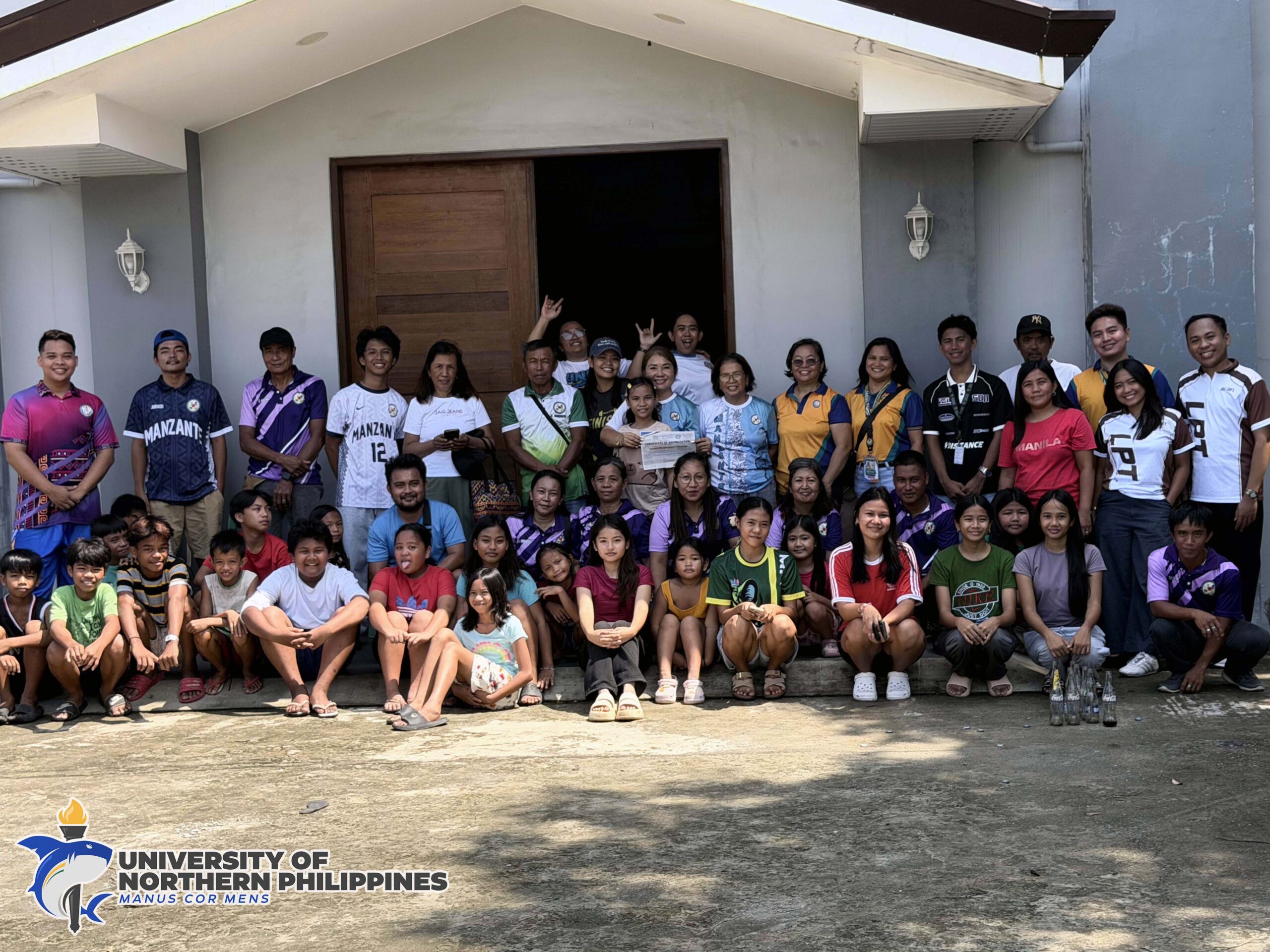
Bringing the transformative power of play, movement, and culture closer to the community, faculty members and selected students from the Master of Arts in Teaching Physical Education, Bachelor of Physical Education, and Bachelor of Culture and Arts Education programs carried out Phase 5 of Project LARO (Localized Application of Recreational Outputs) on September 5, 2026, at the Manzante Covered Court in Magsingal, Ilocos Sur.
The day-long initiative provided participants with hands-on training in game facilitation, safety management, and officiating, equipping them with practical competencies needed to organize and sustain recreational activities in their communities.
Through Project LARO Phase 5, UNP strengthened its commitment to safeguard traditional games as living expressions of culture and valuable tools for holistic learning. Anchored on the University Extension Program’s Cultural Heritage Preservation Program and the College of Teacher Education’s flagship “Securing FUTURE: Cultural Heritage Preservation” initiative, the project sought to ensure that indigenous games remain relevant in generations by integrating them into educational and community-based activities. The undertaking was led by Project Leader Dr. Matilde Concordia and CTE Dean Dr. Ma. Teresa Susan Manzano, with the official approval of UNP President Dr. Erwin Cadorna.
The activity formally commenced with welcome remarks from Manzante Barangay Captain Hon. Madelyn Tabin, who emphasized the importance of community participation in preserving local traditions through meaningful recreational activities. This was followed by the presentation of the orientation modules and game mechanics, led by Dr. Concordia, Mr. Calvin Klein Blanco, Ms. Oliva Navarro, and Mr. Joven Andrian Respicio. Their discussions provided participants with essential guidance on the rules, procedures, and proper conduct of the traditional games, laying the groundwork for a safe, organized, and engaging implementation of Project LARO Phase 5.
Project LARO Phase 5 brought together 94 participants in a vibrant, multigenerational celebration of traditional play, drawing 70 community trainers and participants, 10 youth and community leaders, 10 students, and four faculty members into a shared effort to keep indigenous games relevant and alive. Designed to promote inclusive participation of generations, the activity grouped participants into six age categories, ensuring that children, youth, adults, and senior community members could experience and pass on traditional games.
Participants aged 56 and above engaged in Bulolots and Paway, while those aged 38–55 took part in Paway, Touch the Body, Bulolots, Tangga, and Kuryando. The 30–37 age group played Paway, Touch the Body, Kuryando, and Bulolots, while participants aged 22–29 competed in Touch the Body, Paway, Bulolots, and Chinese Garter.
Younger participants likewise took center stage, with those aged 14–21 competing in Chinese Garter, Touch the Body, Paway, Tangga, and Bulolots. Children aged 6–13 participated in Bulolots, Tangga, Touch the Body, Chinese Garter, and Paway. Through this age-inclusive structure, Project LARO transformed traditional games into a dynamic avenue for intergenerational learning, community participation, physical activity, and cultural transmission, allowing local heritage to be shared from one generation to the next.
To ensure seamless execution, the academic team partnered closely with Manzante Barangay Officials, Sangguniang Kabataan leaders, and the Youth Advocates for Peace and Cultural Heritage. Practical safety management and participant care in all game stages were directly supervised by Barangay Health Workers and Barangay Police.
The activity culminated in a celebration of participation, achievement, and community involvement as YAPAC Founder Ms. Alexis Concordia and Hon. Tabin awarded certificates to all participants and stage winners, recognizing their active contribution to the successful implementation of Project LARO Phase 5. More than a recognition of individual accomplishments, the awarding highlighted the collective commitment of the community to keep traditional games alive and accessible across generations.
The initiative likewise advanced the University’s commitment to the United Nations Sustainable Development Goals (SDGs), particularly SDG 3 (Good Health and Well-Being) through active recreation, SDG 4 (Quality Education) through experiential and culturally grounded learning, SDG 11 (Sustainable Cities and Communities) through heritage preservation and community participation, and SDG 17 (Partnerships for the Goals) through collaborative action among the University, community leaders, and local stakeholders.
Article by Anastacia B. Joven