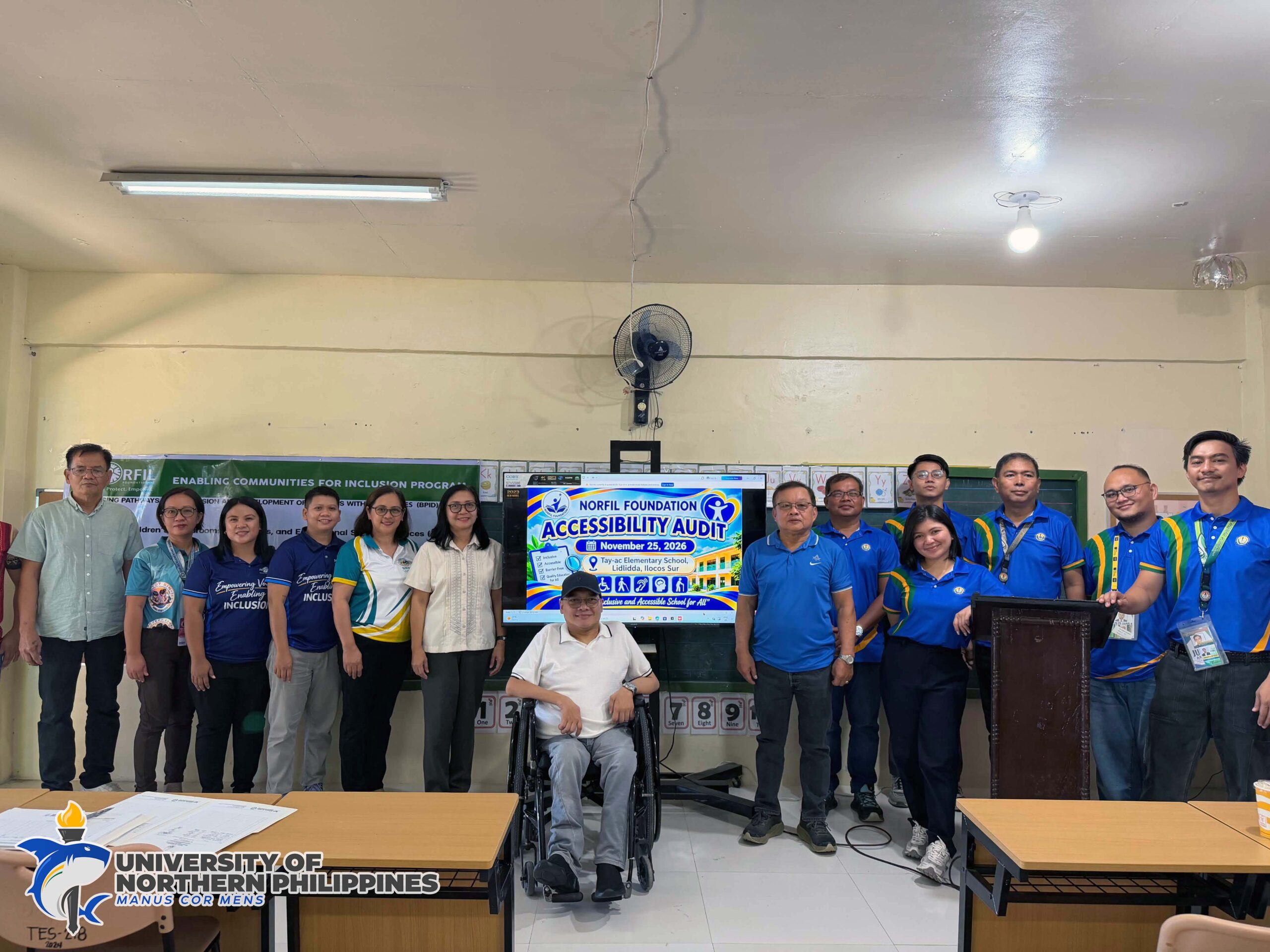
In an effort to promote inclusive, accessible, and barrier-free learning environments, the University of Northern Philippines, through the College of Architecture and Built Environment (CArBE), in collaboration with NORFIL Foundation, conducted an Accessibility Audit at Tay-ac Elementary School, Lidlidda, Ilocos Sur on November 25, 2026.
Sponsored by the NORFIL Foundation, the activity is part of its Enabling Communities for Inclusion Program, implemented through the Bridging Pathways for Inclusion and Development of Persons with Disabilities Project and the Accessible Children’s Classrooms, Restrooms, and Educational Support Services initiative. It also forms part of the foundation’s nationwide series of accessibility assessments aimed at identifying barriers and advancing more inclusive, accessible, and supportive learning environments for all learners, particularly persons with disabilities.
The activity commenced with a lecture by Ar. Don De Vera, faculty member of Mapúa–Malayan Colleges Laguna, who discussed five key considerations in designing and developing accessible environments for persons with disabilities (PWDs). His presentation highlighted the need to integrate accessibility principles into the planning, design, and construction of buildings and public facilities, emphasizing that an inclusive physical environment must go beyond meeting structural requirements to ensure that individuals of varying abilities can move around independently, safely, and with dignity. He also discussed the importance of observing established accessibility standards in removing physical barriers and providing equitable opportunities for PWDs to access facilities, services, and learning spaces without unnecessary restrictions.
Following the lecture, participants proceeded with an on-site accessibility audit of the school’s existing buildings and facilities to determine their compliance with Batas Pambansa Blg. 344, otherwise known as the Accessibility Law. The assessment involved examining the physical features and structural provisions of the school environment, identifying existing obstacles that may limit the mobility and participation of learners with disabilities, and determining areas that require modifications or additional accessibility features. Through this systematic evaluation, the activity sought to generate practical recommendations for improving the school’s facilities and ensuring that classrooms, passageways, restrooms, and other essential spaces are accessible and responsive to the needs of learners with diverse abilities.
Representing UNP-CArBE were Ar. Julius Artates, Ar. Charles Angelo Andrada, Ar. Gener Retuta, Ar. Queenie Quintinita, Ar. Gren Ivyn Guzman, and Ar. Ronel Carlos Ramos, who provided their architectural knowledge and technical expertise in evaluating the school’s existing facilities. Their participation contributed professional insights into identifying structural and environmental barriers, assessing compliance with accessibility requirements, and determining practical interventions to make the school premises more responsive to the needs of learners with disabilities.
The activity also brought together key stakeholders from the education sector, local government, and the community, including Mr. George Arcaparlas, NORFIL Foundation Project In-Charge; Ms. Buenafe Medrano, Public Schools District Supervisor; Ms. Jeniffer Orpilla, Teacher-in-Charge of Tay-ac Elementary School; Sangguniang Bayan Members Hon. Bili Gibawan and Hon. Punciano Bagbagen; representatives of the Local Government Unit of Lidlidda; teachers of Tay-ac Elementary School; and members of the local community. Their participation provided an avenue for exchanging perspectives and identifying accessibility concerns that require coordinated action, ensuring that the assessment considered not only technical standards but also the actual experiences and needs of the school’s stakeholders.
Through this collaborative undertaking, UNP and the NORFIL Foundation highlighted the value of bringing together architectural professionals, education authorities, local government officials, and community members in addressing physical barriers to inclusive education. The partnership recognizes that creating accessible learning environments requires more than infrastructure improvements; it also demands shared responsibility, informed planning, and sustained cooperation among institutions and communities to ensure that learners, regardless of physical ability, can access educational facilities and participate meaningfully in school activities.
The initiative likewise demonstrates the University’s commitment in translating its academic and professional expertise into meaningful community interventions. By mobilizing the technical capabilities of its architecture faculty and personnel, UNP-CArBE extends its role beyond instruction and professional training, contributing to the development of safer, barrier-free, and inclusive learning spaces. Through engagements of this nature, the University continues to support efforts that uphold the rights, dignity, and educational opportunities of persons with disabilities while helping build communities where every learner is given an equitable opportunity to participate, develop, and thrive.