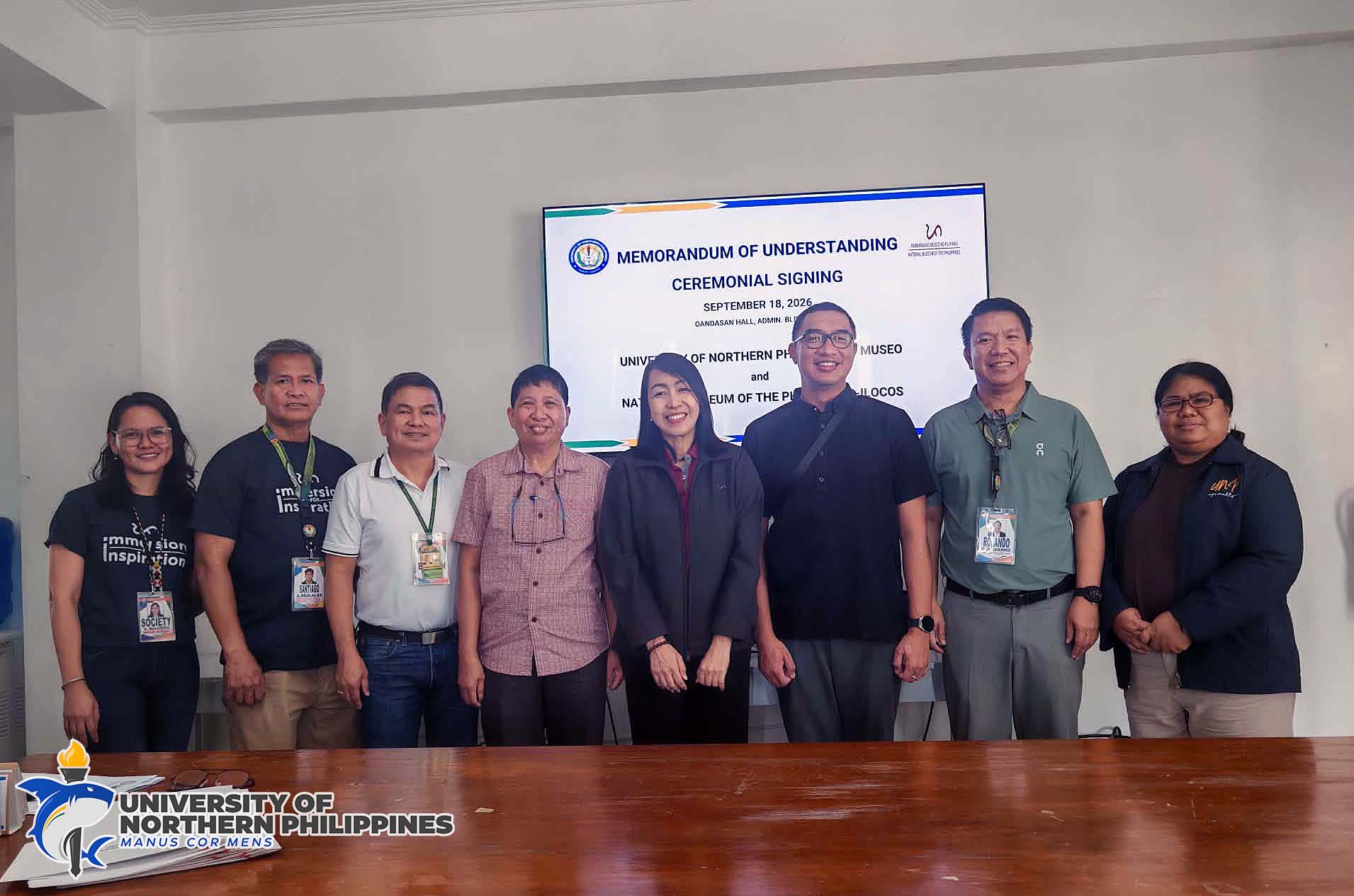
The University of Northern Philippines strengthened its commitment to preserve cultural heritage, advance academic research, and expand experiential learning opportunities as it forged a memorandum of understanding (MOU) with the National Museum of the Philippines–Ilocos on September 18, 2026 at Oandasan Hall.
The partnership, facilitated by the Office of the Vice President for Academic Affairs through the UNP–Museo de la Unibersidad, establishes a framework for sustained collaboration between the University and the National Museum in the areas of academic and cultural research, museum education, heritage conservation, student internship, exhibition development, and community capacity-building.
UNP President Dr. Erwin Cadorna signed the agreement for the University, while Dr. Michael Armand Canilao, Director II of the Northern Luzon National Museums, signed on behalf of the National Museum of the Philippines.
The signing was witnessed by Dr. Rolando Navarro, Vice President for Academic Affairs; Dr. Santiago Reolalas, Head of the Museo de la Unibersidad; Ms. Honey Beso, Director II of the Southern Luzon National Museums; and Ms. Maria Lourdes Ingel, Officer-in-Charge of the National Museum of the Philippines–Ilocos.
The MOU signing was also witnessed by Dr. Eleonor Belizar, Special Assistant to the President; Dr. Ma. Teresa Mazano, Dean of the College of Teacher Education; Ar. Mon Cres Toje, OIC Dean of the College of Architecture and Built Environment; and Dr. Society Salcedo, Assistant Head of the Museo de la Unibersidad.
Under the agreement, UNP will strengthen its academic and cultural research initiatives by encouraging its various academic units to conduct relevant studies in coordination with the Center for Ilokano Studies and the Museo de la Unibersidad. The partnership is expected to provide a stronger academic foundation for museum programs, exhibitions, heritage initiatives, and other activities that contribute to the documentation and appreciation of Ilokano and Philippine culture.
The University will likewise enhance the curricula of concerned degree programs to ensure that student interns gain meaningful training and broader exposure to museum operations and cultural activities. Through practical experiences in an actual museum setting, students will have opportunities to apply classroom-based knowledge in areas related to heritage, collections, visitor services, exhibition development, and museum management.
The MOU further calls on UNP academic units to integrate the partnership with the National Museum of the Philippines into their respective programs. In particular, the College of Hospitality and Tourism Management, College of Fine Arts and Design, College of Teacher Education, and College of Public Administration will strengthen their practicum programs in support of museum operations and cultural initiatives.
The College of Fine Arts and Design will also pursue heritage art initiatives with the National Museum of the Philippines–Ilocos, opening avenues for students and faculty members to contribute to the preservation, interpretation, and creative presentation of cultural heritage.
Another key responsibility of UNP is to ensure the security and protection of exhibition spaces. The University will utilize appropriate areas, including spaces such as the second floor of Diego Silang Hall, to help mitigate risks associated with local flooding and prevent mold growth. These measures are intended to safeguard cultural collections while also protecting the health and safety of museum personnel.
The University and the National Museum will also jointly design training programs aimed at sharing expertise and building the capacities of personnel, students, and community members, including Indigenous Cultural Communities. These programs are envisioned to strengthen appreciation for cultural heritage while promoting broader community participation in heritage preservation and museum-related initiatives.
For its part, the National Museum of the Philippines–Vigan City will provide technical and professional support to the University in developing exhibitions for the Museo de la Unibersidad. It will assist in ensuring that exhibitions are properly coordinated with their respective themes and are actively narrative-driven, drawing from research undertaken by UNP and research materials made available by both parties.
The National Museum will also extend expert technical assistance in the organization and arrangement of collections and in exhibition design, particularly as the Museo de la Unibersidad transitions to its new location. Such collaboration is expected to enhance the museum’s capacity to present collections in a more coherent, informative, and engaging manner.
In addition, the National Museum will work with UNP academic units in enhancing curricula and maximizing student internship experiences, particularly in visitor operations and museum management. This will complement the University’s efforts to provide students with practical and professionally relevant learning experiences beyond the traditional classroom environment.
Both institutions will further collaborate in designing training programs for university personnel, students, and community stakeholders, creating opportunities for knowledge exchange and professional development while strengthening the role of museums and academic institutions in cultural education and heritage stewardship.
The MOU reflects UNP’s continuing efforts to connect academic instruction, research, cultural preservation, and community engagement. Through the collaboration, the University and the National Museum of the Philippines–Vigan City seek to create stronger institutional mechanisms for documenting, interpreting, protecting, and promoting cultural heritage while providing students and communities with greater opportunities to participate in meaningful cultural and educational activities.
With the Museo de la Unibersidad serving as an important platform for heritage education and cultural engagement, the partnership is poised to further strengthen UNP’s role in preserving and communicating the rich history and cultural identity of Ilocos Sur and Northern Luzon.