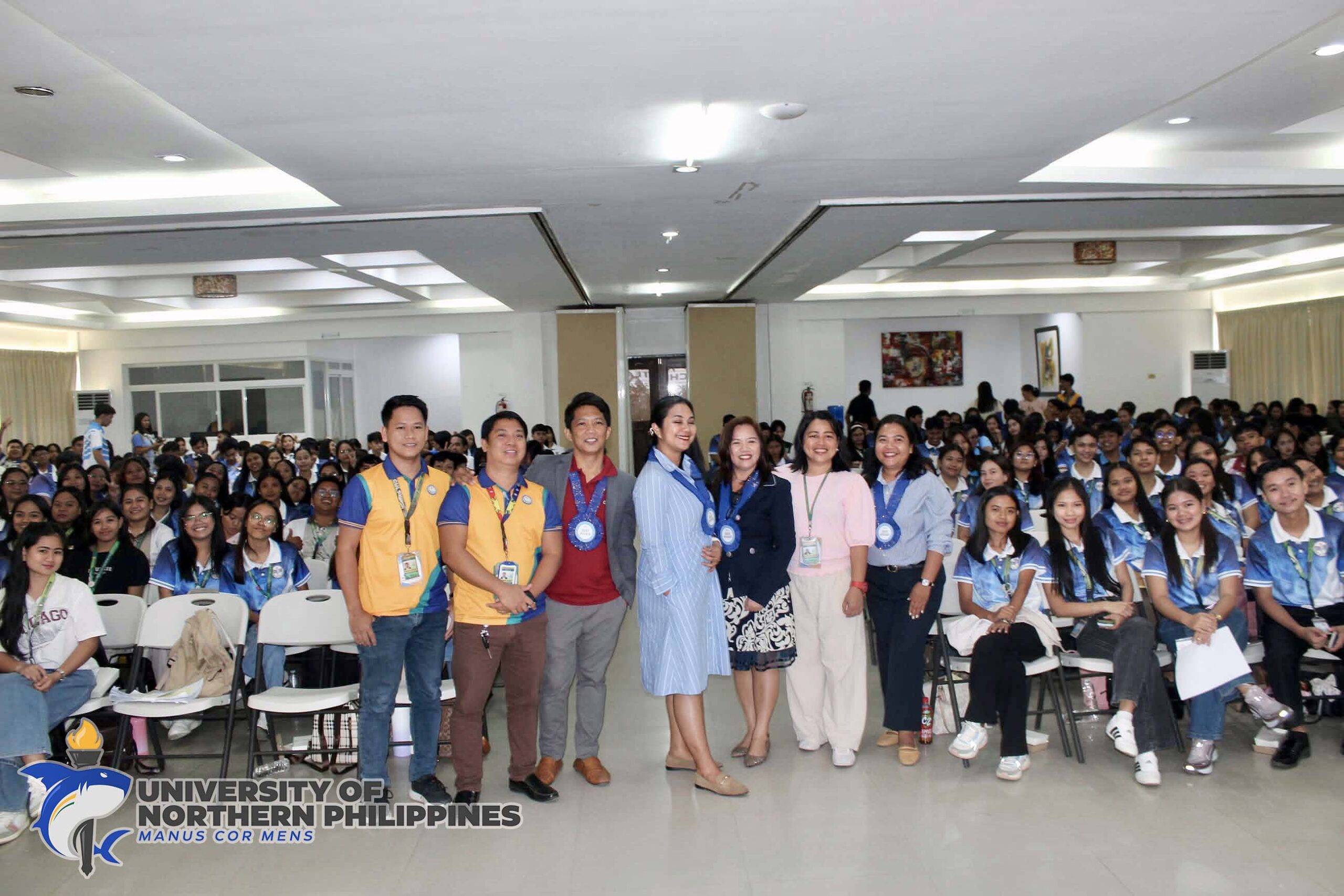
Preparing educators for the evolving landscape of Philippine basic education, the University of Northern Philippines College of Teacher Education (UNP-CTE) convened the seminar-workshop “Future-Ready Teachers: Embracing the Revised and Strengthened K-12 Curriculum 2026” on October 8, 2026 at Tadena Hall, equipping future teachers with insights into the curriculum reforms shaping the next generation of teaching and learning.
The seminar-workshop brought together pre-service teachers from the Bachelor of Secondary Education, Bachelor of Physical Education, Bachelor of Technology and Livelihood Education, and Bachelor of Technical-Vocational Teacher Education programs to deepen their understanding of the revised and strengthened K–12 curriculum. Through the activity, participants were equipped with essential knowledge and skills in lesson planning, instructional design, and curriculum mapping to better prepare them for the demands of classroom instruction and their future roles as educators.
In her welcome address, Dr. Ma. Teresa Susan Manzano, Dean of the College of Teacher Education, stressed that continuous professional learning is essential for future educators to remain effective and responsive in an evolving educational landscape. She emphasized that being future-ready means maintaining a commitment to lifelong learning, professional growth, and the constant pursuit of better teaching practices.
“The teacher of the future cannot afford to say, ‘I already know enough.’ Rather, the future-ready teacher says, ‘There is always more to learn, improve, explore, and share,’” she said.
Dr. Manzano further emphasized that beyond mastering new teaching approaches and adapting to curriculum reforms, future-ready educators must remain compassionate and attentive to learners’ diverse needs, ensuring that educational progress goes hand in hand with meaningful and responsive teaching.
Meanwhile, University President Dr. Erwin Cadorna emphasized that preparing future-ready teachers requires more than developing academic competence and technical skills; it also demands the cultivation of strong character, positive values, and responsible behavior. He stressed that effective educators must exemplify integrity and professionalism while creating learning environments that nurture both the intellectual and personal development of their students.
Dr. Cadorna also encouraged pre-service teachers to recognize artificial intelligence as a valuable tool that can enhance teaching strategies, support learning activities, and improve instructional delivery. However, he emphasized that technology should complement, rather than replace, the essential role of teachers in educating and guiding learners. He highlighted the importance of human judgment, responsible decision-making, and meaningful teacher-learner relationships in ensuring that technological advancements contribute to quality education.
The morning session featured UNP alumnus Dr. Jowell Pilotin, who discussed the General Shaping Paper and Instructional design Framework, highlighting the key directions of the revised and strengthened K–12 Curriculum and the need to align instructional planning with prescribed competencies and intended learning outcomes. He explained how a structured instructional design framework can help teachers systematically organize learning experiences, select appropriate teaching strategies, and ensure that classroom instruction supports the attainment of established educational objectives.
The session was followed by a discussion on the guidelines on lesson planning and lesson design using the ILAW format, facilitated by Dr. Cecilia Saldua. Her presentation focused on the fundamental principles of effective lesson planning, emphasizing the importance of establishing clear learning objectives and ensuring coherence among instructional activities, teaching approaches, and assessment strategies. The session equipped pre-service teachers with practical guidance for developing well-structured, learner-centered lessons aligned with curriculum requirements and desired learning outcomes.
In the afternoon, participants engaged in breakout sessions organized according to their respective learning areas, focusing on curriculum walkthrough and curriculum mapping and unpacking. These sessions allowed pre-service teachers to examine curriculum standards and expectations, identify essential learning competencies, and explore practical ways to translate curriculum requirements into purposeful, well-structured, and learner-centered classroom instruction.
Through collaborative discussions and hands-on activities, the seminar-workshop strengthened participants’ understanding of curriculum implementation and the importance of aligning learning objectives, instructional approaches, and assessment strategies. The sessions also highlighted the need for future educators to adapt effectively to curriculum reforms, employ appropriate teaching strategies, and address the diverse abilities, needs, and learning contexts of their students.
The initiative reflected the College of Teacher Education’s continuing commitment to deliver quality, outcomes-based teacher education in support of Sustainable Development Goal 4 (Quality Education). Ultimately, the activity emphasized that becoming a future-ready teacher goes beyond adapting to curriculum reforms and technological advancements; it demands continuous professional learning, instructional flexibility, and an unwavering commitment to provide inclusive, responsive, and meaningful learning experiences for every student.
Article by Arthur Pascua, Photos by Joshua Padron & Hero Clayd Pilien