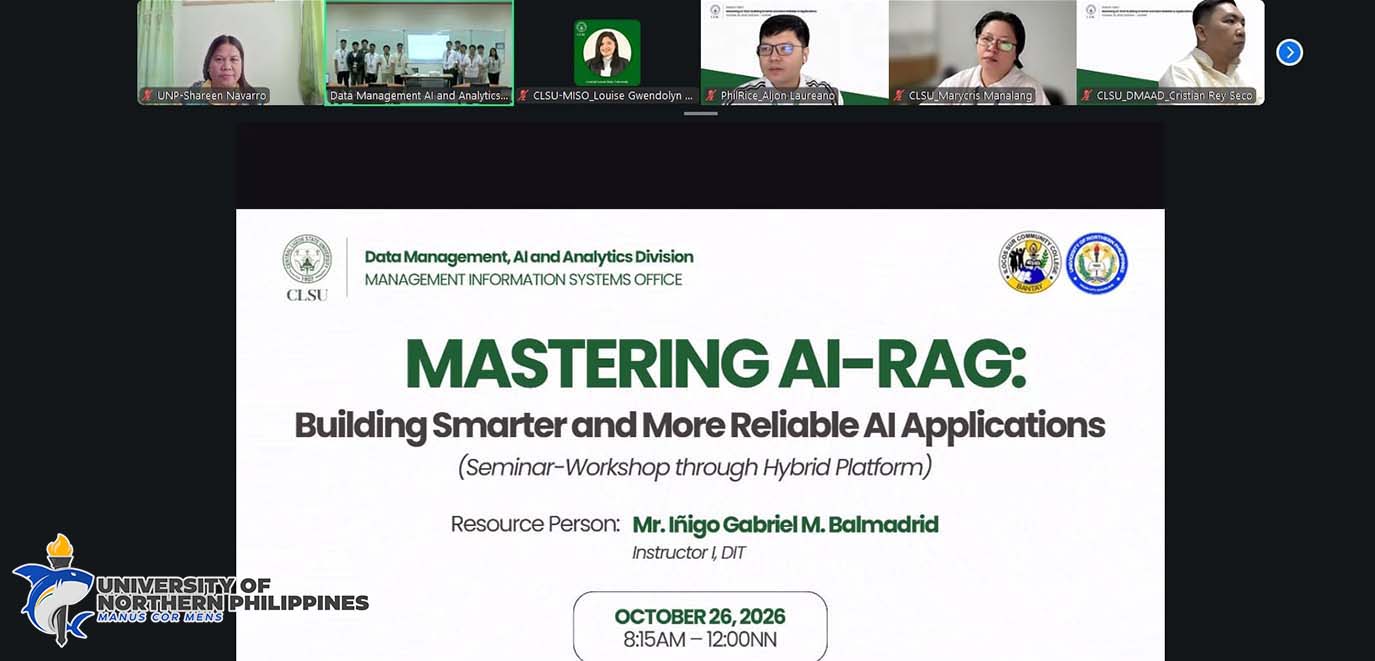
Advancing digital transformation and pushing the boundaries of artificial intelligence in higher education, the University of Northern Philippines, in partnership with Central Luzon State University (CLSU) and Ilocos Sur Community College (ISCC), successfully hosted a regional hybrid seminar-workshop on “Mastering AI-RAG: Building Smarter and More Reliable AI Applications” on October 26, 2026.
The collaboration formed part of a broader initiative to advance sustainable digital transformation in higher education, spearheaded by the Data Management, AI and Analytics Division (DMAAD) of the Central Luzon State University Management Information Systems Office (CLSU-MISO). Through the regional hybrid seminar-workshop, the partner institutions sought to strengthen institutional capabilities in artificial intelligence and promote the development of smarter, more reliable AI applications responsive to the operational requirements of higher education institutions.
Representing the University of Northern Philippines, Dr. Shareen Navarro, Director of the Information and Communications Technology Office (ICTO) and faculty member of the College of Business Administration and Accountancy, delivered the university’s solidarity remarks, reaffirming its support for collaborative initiatives that advance digital innovation and technological development in higher education. Her participation highlighted UNP’s engagement in interinstitutional partnerships that promote knowledge-sharing and the adoption of emerging technologies to improve institutional processes and services.
Also representing UNP were Dr. Honey Girl Avo and Dr. Marie Louie Abraham Paz of the College of Communication and Information Technology (CCIT), who served as institutional focal persons. Their involvement contributed to the university’s participation in the collaborative learning initiative, which brought together academic and technical personnel to explore the practical applications of artificial intelligence and retrieval-augmented generation in developing more efficient and dependable AI-powered solutions.
The seminar-workshop was organized through the collaborative efforts of Dr. Cristian Rey Seco, Chief of CLSU-MISO DMAAD and overall event chair; Dr. Khavee Augustus Botangen, Director of CLSU-MISO; Dr. Eulaine Bennette Cariño, BSIT Program Head of Ilocos Sur Community College; and Mr. Alfie Rapisura, Head of Management Information Systems and ISCC focal person. Working with the UNP delegation, these institutional representatives helped align the training with the practical operational needs and digital transformation priorities of the participating institutions.
Through this interinstitutional partnership, UNP, CLSU, and ISCC strengthened their shared commitment to advance technology-driven innovation in higher education. The initiative also provided an avenue for exchanging expertise and exploring AI applications that could support institutional operations, improve information management, and contribute to more responsive and reliable digital services across the academic sector.
Delivering the main technical lecture, Mr. Iñigo Gabriel Balmadrid demonstrated how Retrieval-Augmented Generation (RAG) enhances the accuracy and reliability of artificial intelligence by connecting large language models with relevant, verified information from external knowledge sources. Through hands-on demonstrations and practical exercises, participants from UNP, CLSU, ISCC, government agencies, and the private sector gained practical knowledge and skills in organizing document-based knowledge repositories and developing customized AI applications. The training emphasized how RAG enables AI systems to generate fact-based, precise, and contextually relevant responses while reducing the risk of inaccurate or unsupported outputs, even without extensive programming expertise. By introducing participants to these practical applications, the seminar-workshop provided a foundation for harnessing AI technologies to improve information retrieval, streamline institutional processes, and support more reliable, data-informed decision-making.
Through this collaborative training initiative, the University of Northern Philippines, Central Luzon State University, and Ilocos Sur Community College strengthened their efforts to equip faculty members, staff, and students with practical skills for the responsible integration of artificial intelligence into higher education. The training highlighted how AI-powered tools can support research, streamline administrative processes, and improve technical operations through efficient information retrieval and evidence-based applications.
Among the practical applications explored were the development of customized digital teaching assistants that enable educators, including those without extensive IT backgrounds, to respond to student inquiries using verified course materials; the use of AI tools to facilitate the synthesis and analysis of complex research literature; and the transformation of extensive policy manuals into interactive search systems that allow personnel to retrieve relevant information more efficiently. These applications demonstrated the potential of retrieval-augmented generation to enhance teaching, research, and administrative services while promoting greater accuracy and reliability in information management.
Beyond technical competencies, the seminar-workshop emphasized responsible AI use, highlighting critical considerations such as data privacy compliance, intellectual property protection, the mitigation of algorithmic bias, and the importance of human oversight in academic decision-making. These discussions reinforced the need to ensure that AI adoption remains ethical, secure, transparent, and aligned with institutional policies and academic standards.
The participating institutions also reaffirmed their commitment to sustain the partnership through joint programs, collaborative research, and resource-sharing initiatives in regions. The engagement marked an important step toward strengthening interinstitutional cooperation and expanding opportunities for knowledge exchange, technological innovation, and capacity-building in higher education.
Through this shared commitment, UNP, CLSU, and ISCC continue to recognize the complementary roles of technology and collaboration in shaping the future of education. By combining technical expertise, institutional resources, and responsible innovation, the three institutions aim to advance digital transformation and develop practical AI-driven solutions that respond to the evolving needs of the academic community.