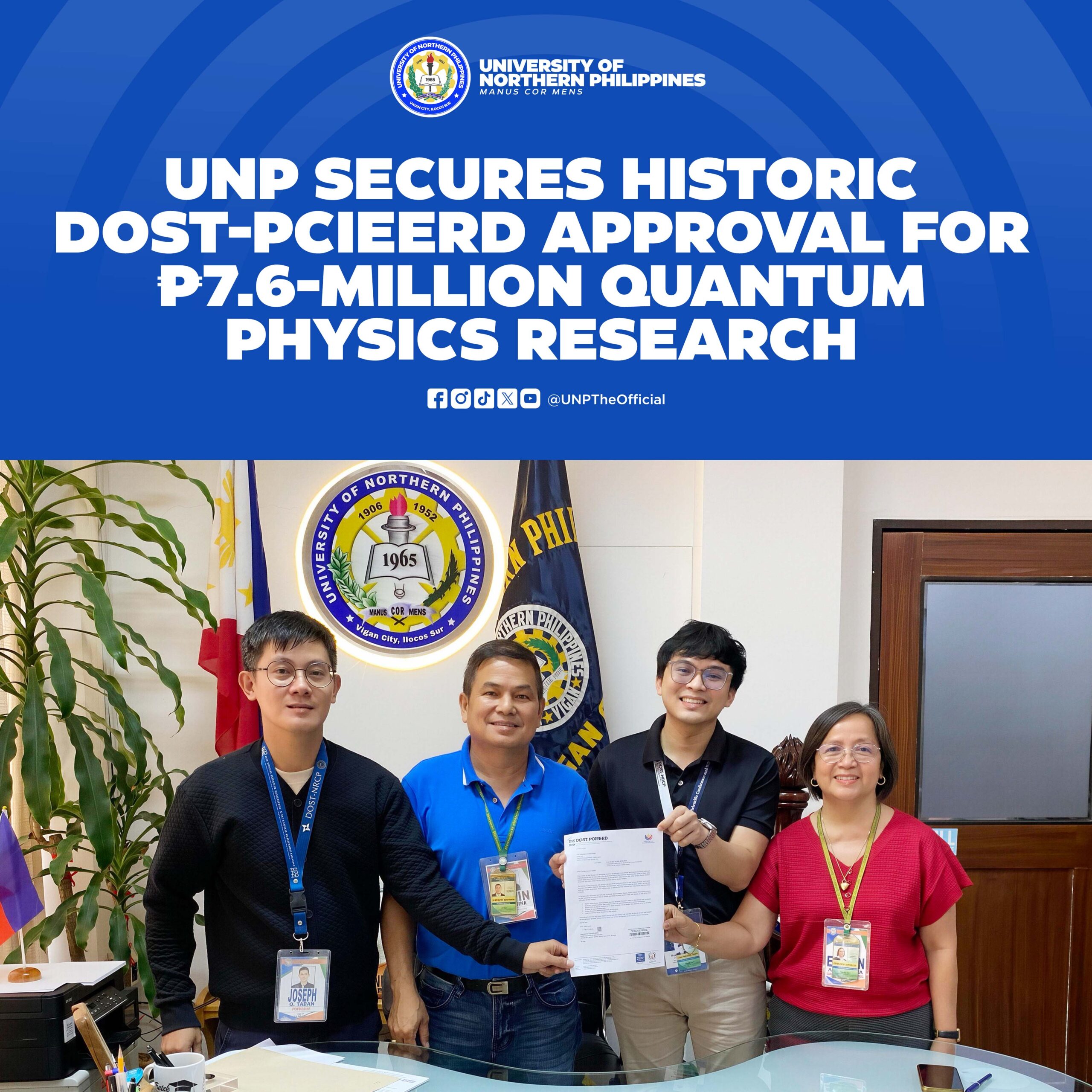
Demonstrating the University of Northern Philippines’ growing research capability and expanding presence in emerging technologies, the DOST-PCIEERD Governing Council has approved UNP’s first externally funded quantum physics research project. The groundbreaking initiative, titled “Formulation of Quantum Speed Limits in Finite-Dimensional Phase Space for Few-Qubit State Preparation, Resource Generation, and Gate Implementation,” comes with a landmark ₱7.6 million in total funding.
The two-year project will be led by Dr. Dean Alvin Pablico, research coordinator of the University Research and Development Office (URDO) and a BS Physics faculty member of the College of Arts and Sciences, in collaboration with Dr. Herbert Domingo of the University of the Philippines Manila and Dr. John Paul Besagas of the Polytechnic University of the Philippines – Sta. Mesa.
The approval was granted during the DOST-PCIEERD Governing Council meeting held on July 17, 2026, through Governing Council Resolution No. 166, series of 2026. UNP received the formal notice of approval on July 31.
The proposal emerged from a highly competitive national call that attracted 808 concept proposals under the Industry, Energy, and Emerging Technology (IEET) sectors for the Calendar Year 2028 DOST-PCIEERD Grants-in-Aid Call for Proposals.
The approval followed a rigorous, multi-stage national evaluation process that assessed the proposal’s scientific merit, national relevance, feasibility, expected impact, institutional capability, sustainability, and value for public investment. The project successfully advanced through division-level screening, review by the PCIEERD Management Team, evaluation by the PCIEERD Technical Panel, and deliberation by the DOST-PCIEERD Governing Council.
In the later stages, Dr. Pablico and his team presented and orally defended the proposal before the Technical Panel and Governing Council, addressing detailed questions on its scientific, technical, financial, and implementation aspects.
The project is aligned with DOST-PCIEERD priority areas in Quantum Information Science, Quantum Computing, and Quantum Simulation. It will study how fast small quantum systems can prepare a desired state, generate useful quantum properties, and perform basic quantum computational operations. Understanding these physical limits can help researchers assess the efficiency of quantum processes and identify the boundaries within which future quantum technologies must operate.
The project carries a total cost of approximately ₱7.6 million, comprising around ₱5.8 million in DOST-PCIEERD funding and approximately ₱1.86 million in counterpart support from UNP, PUP, and UP Manila.
The milestone also reflects the continued support of the University Research and Development Office, under the leadership of Dr. Edelyn Cadorna, which continues to strengthen research development, coordination, and externally funded initiatives across the University.
UNP President Dr. Erwin Cadorna welcomed the approval as a significant institutional achievement and a reflection of the University’s continuing commitment to research and innovation.
“This achievement demonstrates that UNP can lead nationally relevant research in highly specialized and emerging fields. It also reflects the dedication of our faculty researchers and the value of building strong partnerships with leading institutions. We look forward to the opportunities this project will create for our students, researchers, and the wider academic community.”
The project places UNP among Philippine universities advancing government-supported research in Quantum Science and Technology. Through its partnership with UP Manila and PUP, the project also broadens participation beyond the country’s traditional research hubs and strengthens the University’s contribution to the Philippines’ developing capabilities in quantum information, computing, and simulation.
While the proposal was submitted under the Regular Call for Proposals for Calendar Year 2028 funding, the project may receive funding in 2027 or as early as the last quarter of 2026, depending on the availability of DOST funds and the completion of the necessary administrative and pre-implementation requirements.
More than a funding milestone, the approval marks a new chapter in UNP’s research journey and strengthens the University’s foundation for future work in Quantum Science and Technology.