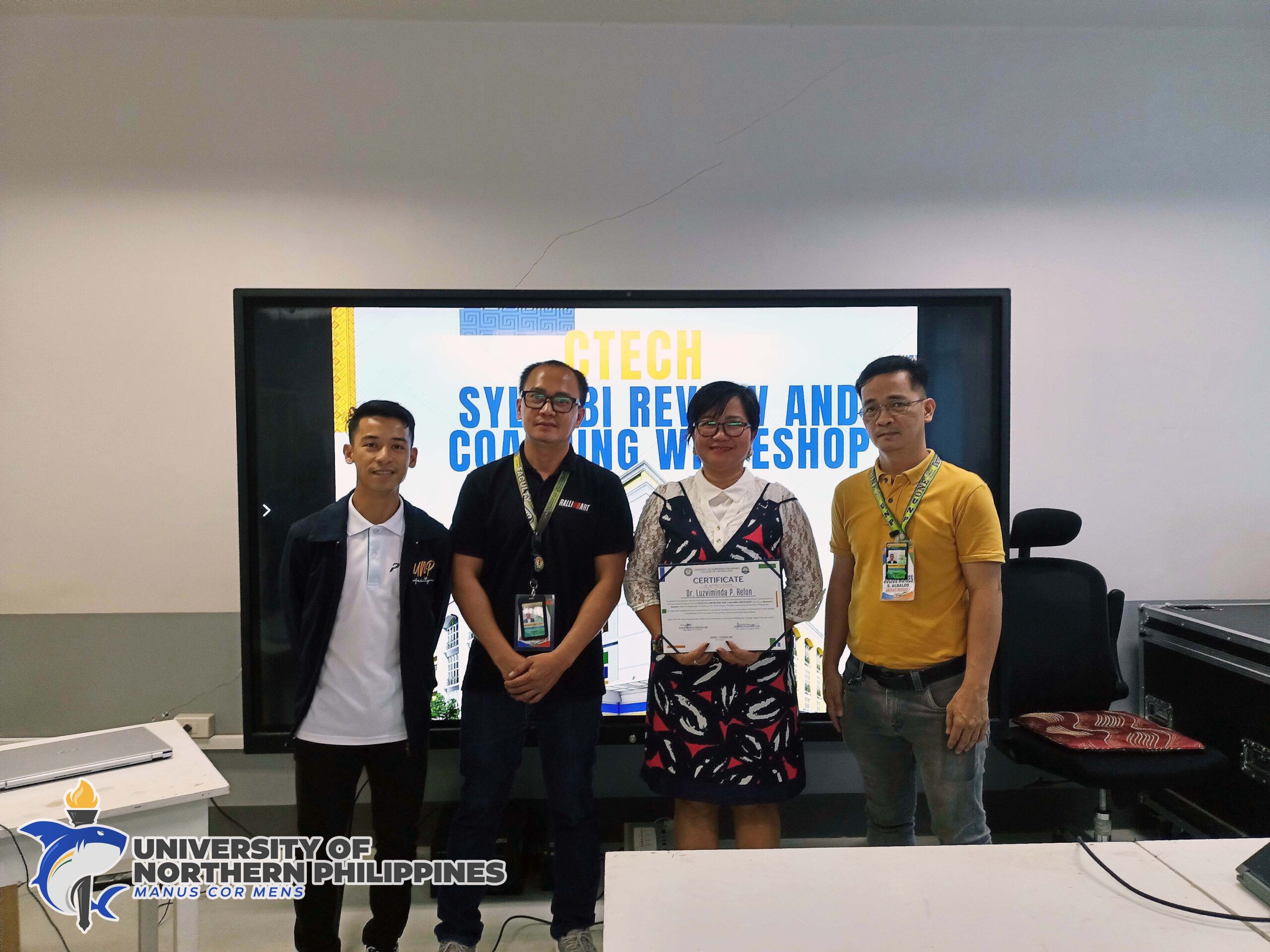
The University of Northern Philippines College of Technology (CTech) strengthened its commitment to curriculum quality and instructional excellence through a Syllabi Review and Coaching Writeshop held on September 4, 2026 at the Technology Complex Building.
The activity brought together CTech faculty members in a collaborative effort to strengthen the quality, coherence, and relevance of instruction across the Bachelor of Science in Industrial Technology and Bachelor of Science in Mechatronis and Automation Technology programs. Through systematic syllabus review and coaching, faculty members examined course content, learning outcomes, teaching strategies, assessment methods, and other key instructional components to ensure their alignment with UNP academic standards and current educational frameworks.
Beyond revising course documents, the writeshop provided an avenue for faculty members to refine their approaches to curriculum delivery and ensure that classroom instruction remains outcomes-based, learner-centered, and responsive to evolving academic and professional demands. The initiative likewise reinforced CTECH’s continuing pursuit of curriculum excellence by promoting consistency in course design while giving faculty members practical guidance in translating institutional standards into meaningful learning experiences for students.
Opening the activity, Dr. Julius Moises Albalos, Dean of the College of Technology, emphasized the importance of continuous improvement in teaching and course delivery, emphasizing the faculty’s responsibility to ensure that instruction remains responsive to the evolving needs of learners and the demands of higher education.
Meanwhile, Dr. Allan Guillermo, Assistant Dean, presented the rationale behind the writeshop, stressing that a carefully designed syllabus serves as a vital foundation for effective teaching and learning. He highlighted its role in clearly defining learning outcomes, organizing instructional content, guiding assessment, and creating meaningful and purposeful learning experiences for students.
The activity thus positioned syllabus enhancement not merely as a documentation requirement, but as an essential step toward strengthening the overall quality and effectiveness of instruction.
The writeshop featured a series of focused discussions designed to deepen faculty understanding of instructional standards and outcomes-based curriculum development. Dr. Luzviminda Relon, Director of the Instructional Faculty Development Office (IFDO), led the discussion on “The Teaching Profession in BSIT and BSMAT: Instructional and Institutional Standards at the University of Northern Philippines,” emphasizing the responsibilities of faculty members in upholding academic and institutional standards in the two programs.
This was followed by Mr. Lesther Aaron, Head of Curriculum and Instruction Materials Development, who presented the “Guidelines on Syllabus Development and Formulating Learning Outcomes Based Education Framework.” His presentation provided faculty members with practical guidance on designing syllabi that establish clear and measurable learning outcomes while ensuring coherence among course content, learning activities, teaching strategies, and assessment methods.
Further broadening the writeshop’s focus on relevant and responsive education, Dr. Juvie Lynne Almachar, Head of Continuing Professional Development, highlighted the integration of Sustainable Pedagogies, Disaster Risk Reduction and Management (DRRM), and the United Nations Sustainable Development Goals (UN SDGs) into the core curricula of the BSIT and BSMAT programs.
Her discussion emphasized the importance of embedding sustainability, resilience, and global development priorities within academic instruction, enabling students to develop not only technical and disciplinary competencies but also the knowledge and perspectives needed to respond to pressing environmental, social, and disaster-related challenges.
The workshop provided CTech faculty members with an avenue to critically examine and enhance their respective syllabi through presentations, peer review, and focused coaching. Faculty members were given the opportunity to present course requirements and instructional plans, receive constructive feedback, and identify specific areas for improvement. The sessions also allowed participants to clarify concerns, revisit course content, and strengthen the use of appropriate teaching, learning, and assessment strategies.
Beyond the technical review of syllabi, the collaborative discussions encouraged faculty members to reflect on their classroom practices and consider approaches that could make instruction more engaging, purposeful, and responsive to students’ needs. The exchange of insights and recommendations further promoted consistency in academic practice while supporting faculty members in translating institutional expectations into effective classroom instruction.
Article by John Jericho Arquines