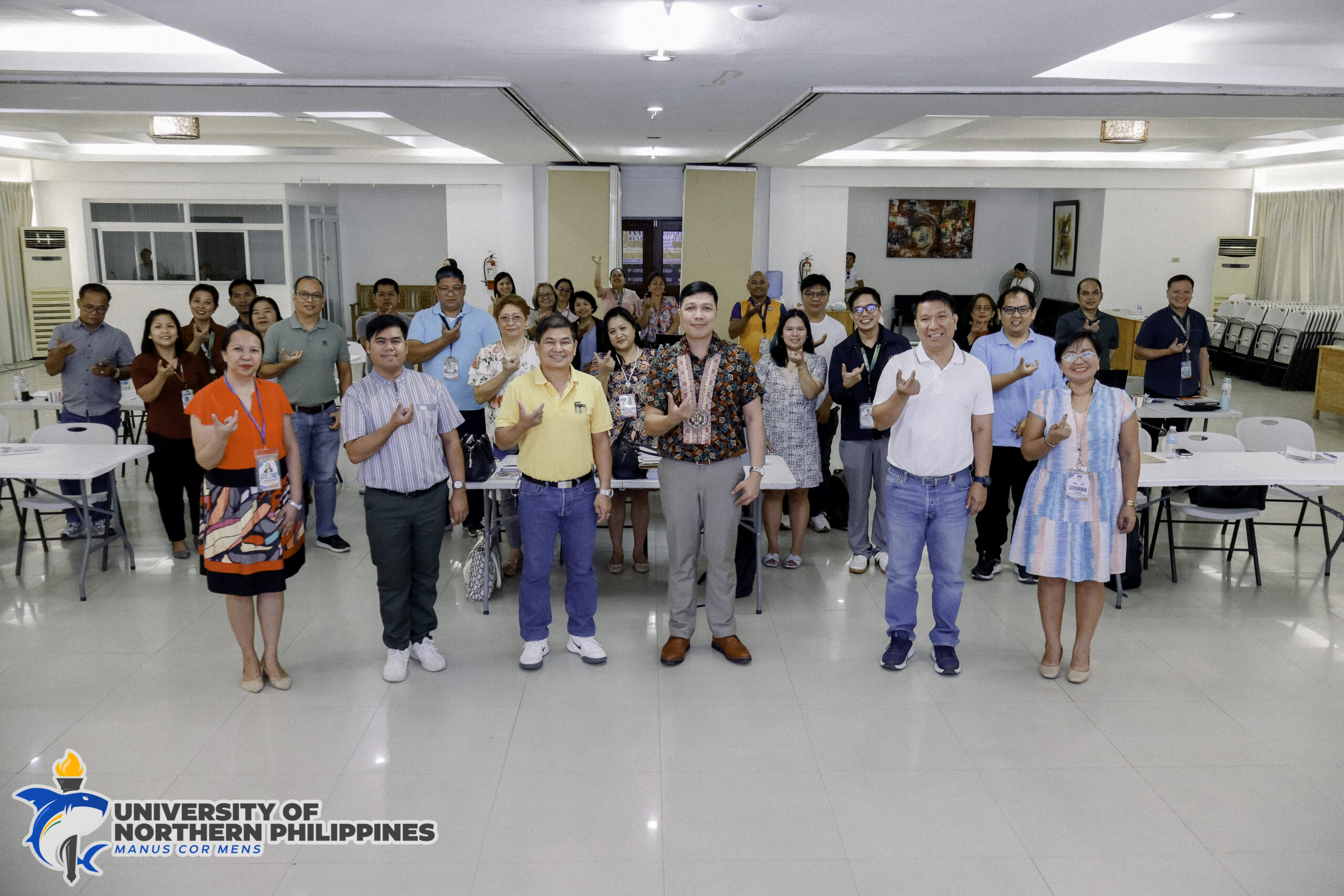
The Office of the Vice President for Academic Affairs and the Instruction and Faculty Development Office of the University of Northern Philippines spearheaded the Graduate Studies Curriculum Summit with the theme “Revisiting the Graduate Programs for Acceptability and Relevance in a Shifting Global Context” held on May 20–21, 2026 at the Romualdo B. Tadena Hall.
The activity was undertaken to comprehensively revisit and enhance the graduate curricula in full adherence to the provisions of CMO No. 15, s. 2019 and CMO No. 21, s. 2025, which outline the Policies, Standards, and Guidelines for Graduate Programs. Conducted as a two-day academic summit, the Graduate Studies Curriculum Summit served as a strategic platform for rigorous evaluation, collaborative discourse, and curriculum strengthening. The undertaking highlighted the institution’s commitment to academic excellence by ensuring that its graduate programs remain relevant, innovative, outcomes-based, and responsive to the evolving demands of education, industry, and the global professional landscape.
The program officially commenced with the welcome remarks of Vice President for Academic Affairs Dr. Rolando Navarro, who highlighted the importance of unity, collaboration, and collective accountability in strengthening graduate education. He stressed that the pursuit of academic excellence and institutional growth rests on the shared commitment of the academic community to continuously innovate, uphold quality standards, and respond to the evolving demands of higher education.
Dr Luzviminda Relon, Director of the Instruction and Faculty Development Office, presented the rationale and statement of purpose, clearly outlining the objectives and significance of the summit. She highlighted the need to revisit existing graduate programs and ensure their alignment with emerging educational trends and global expectations.
UNP President Dr. Erwin Cadorna, in his message, reaffirmed the university’s enduring commitment to strengthen graduate education through quality, relevance, and innovation. He highlighted the importance of continuously enhancing academic programs to remain responsive to the changing demands of higher education and the global academic landscape. Dr. Cadorna further emphasized that dynamic and forward-thinking graduate programs are essential in shaping highly competent professionals, transformative leaders, and research-oriented scholars who can drive progress and contribute responsive solutions to contemporary societal issues.
A major highlight of Day 1 was the keynote presentation delivered by Dr. Al Gerald Barde, Education Program Supervisor II of CHED Regional Office I, whose insights became a defining component of the summit discussions. In his presentation, Dr. Barde emphasized that the strength of a graduate program lies in clearly articulated and well-designed program outcomes that promote curriculum maturity, ensure compliance with academic standards, and establish strong alignment among learning outcomes, instructional delivery, and assessment practices. He further emphasized the importance of innovation and inclusivity in curriculum design, stressing that meaningful curriculum development must involve consultations with key stakeholders to guarantee responsiveness to the evolving demands of industry and society.
The session provided participants with a broader understanding of the current realities, emerging trends, and evolving demands that continue to shape graduate education in a shifting global context. Through the discussion, participants gained a deeper awareness of key considerations for ensuring that graduate programs remain relevant, responsive, and aligned with contemporary educational and professional standards. The presentation also emphasized the importance of continuous curriculum review and adaptation to sustain academic quality and institutional competitiveness.
The session generated meaningful engagement among participants and served as a foundation for the succeeding workshop activities and discussions. Day 1 concluded with productive exchanges and collaborative efforts that set a strong direction for the summit’s subsequent activities.
The second day of the summit formally opened with a solemn prayer, followed by the Synthesis of Day 1 delivered by Dr. Scott Jason Llanes, who revisited the key discussions, emerging themes, and significant insights gathered from the previous day’s engagements. Building on the momentum of the summit, participants proceeded with collaborative workshop sessions focused on revisiting the Graduate Studies Student Manual. Faculty members, academic leaders, and stakeholders carefully examined existing provisions, policies, and guidelines to identify areas requiring enhancement and greater responsiveness to the evolving needs of graduate education.
One of the major highlights of Day 2 was the presentation and critiquing of the Graduate Studies Student Manual, which fostered meaningful academic discourse, constructive evaluation, and collective efforts toward strengthening institutional policies and advancing the quality of graduate studies.