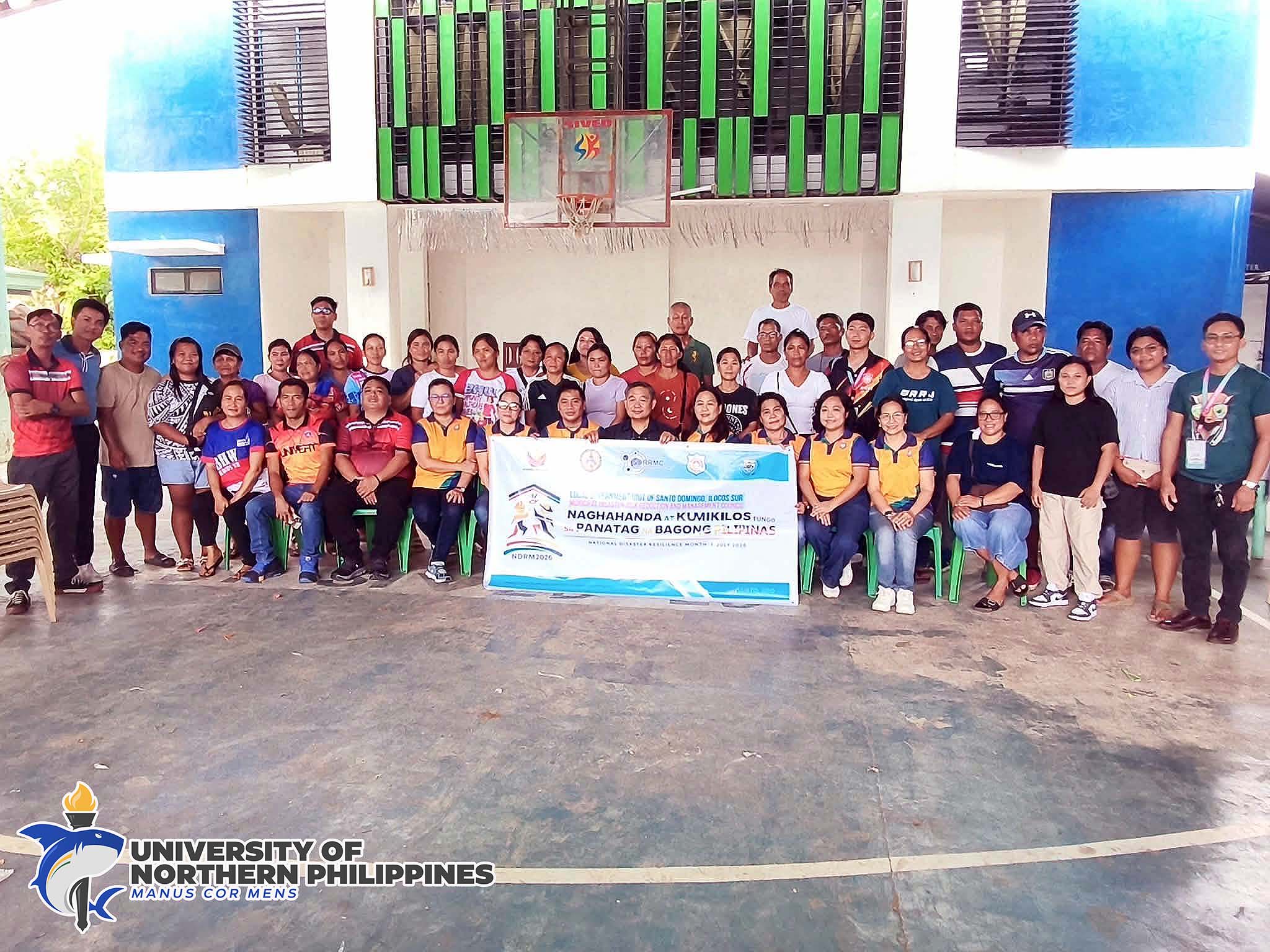
Demonstrating its commitment to community resilience and disaster preparedness, the University of Northern Philippines, through the College of Open and Distance Education (CODE) and the University Extension Office, in partnership with Sto. Domingo Local Disaster Risk Reduction and Management Office, conducted a two-day Emergency Medical Response Training for community members in Barangay Sived, Sto. Domingo, Ilocos Sur on July 13–14, 2026.
The capacity-building initiative brought together residents from three barangays—Sived, headed by Barangay Captain Rouyel Dominic Torricer; Calay-ab, led by Barangay Captain Flor Tabangcura; and Casili, under the leadership of Barangay Captain Larry Dieza—to strengthen their knowledge and practical skills in emergency response, first aid, and lifesaving interventions.
During the opening program, Sto. Domingo Local Disaster Risk Reduction and Management Officer Ms. Sessie de Vera expressed her appreciation to the University for extending its expertise to local communities through a comprehensive emergency response training.
In his message, Dr. Wilson Tolio, Assistant Dean of CODE, encouraged the participants to embrace the training with enthusiasm and commitment. He emphasized that every lesson and hands-on activity would equip them with practical emergency response skills, empowering them to become capable first responders and valuable partners in building a safer, more resilient community.
Meanwhile, Mr. Jastin Soria, UNP Extension Coordinator for Disaster Risk Reduction Management, outlined the objectives and activities of the two-day program, emphasizing the importance of empowering communities with the competencies needed to respond effectively during emergencies and disasters.
The first day of the training focused on the foundations of emergency medical response. Mr. Greg Quilana Quilana discussed the Principles of Emergency Care, while Ms. Leila Sylvia Bautista and Ms. Lorena Darisan facilitated sessions on Common Medical and Trauma Emergencies. Participants also underwent hands-on demonstrations on Bandaging led by Dr. Karen David and Ms. Jihan Heidee Bitonio, and Splinting facilitated by Ms. Adora Velasco and Ms. Almira Gonzales.
On the second day, participants further enhanced their lifesaving competencies through advanced Basic Life Support training facilitated by Ms. Maria Yolanda Aquino and Ms. Ruth Regina Corpuz. They also received practical instruction on Carries, Rescue and Transfer Techniques, and Spine Board Management from Mr. Jose Unciano, Mr. Vincent Viste, Mr. Mark Christian Arizala, Mr. Venerand dela Cruz, Ms. Geraldine Palomares, and Ms. Maria Christina Alcausin. Through simulations and practical exercises, participants gained firsthand experience in safely transporting and managing victims during emergency situations.
The training was facilitated by faculty members from the UNP College of Health Sciences and members of the University Emergency Response Team (UNIVERT), reflecting the University’s multidisciplinary approach to community extension and disaster risk reduction.
Providing operational support throughout the activity were members of the UNIVERT—Mr. Ian Dacanay, Mr. Warmie Tabuso, Mr. Jomar Rabago, and Mr. Jay ar Joshua Tolentino of CODE—who assisted in the conduct of demonstrations, simulations, and participant activities.
The successful conduct of the Emergency Medical Response Training emphasizes UNP’s continuing commitment in extending quality education beyond the classroom by equipping communities with essential disaster preparedness and emergency response skills. Through strategic partnerships with local government units and community stakeholders, the University continues to empower citizens to become capable first responders, contributing to safer, more resilient, and disaster-ready communities.