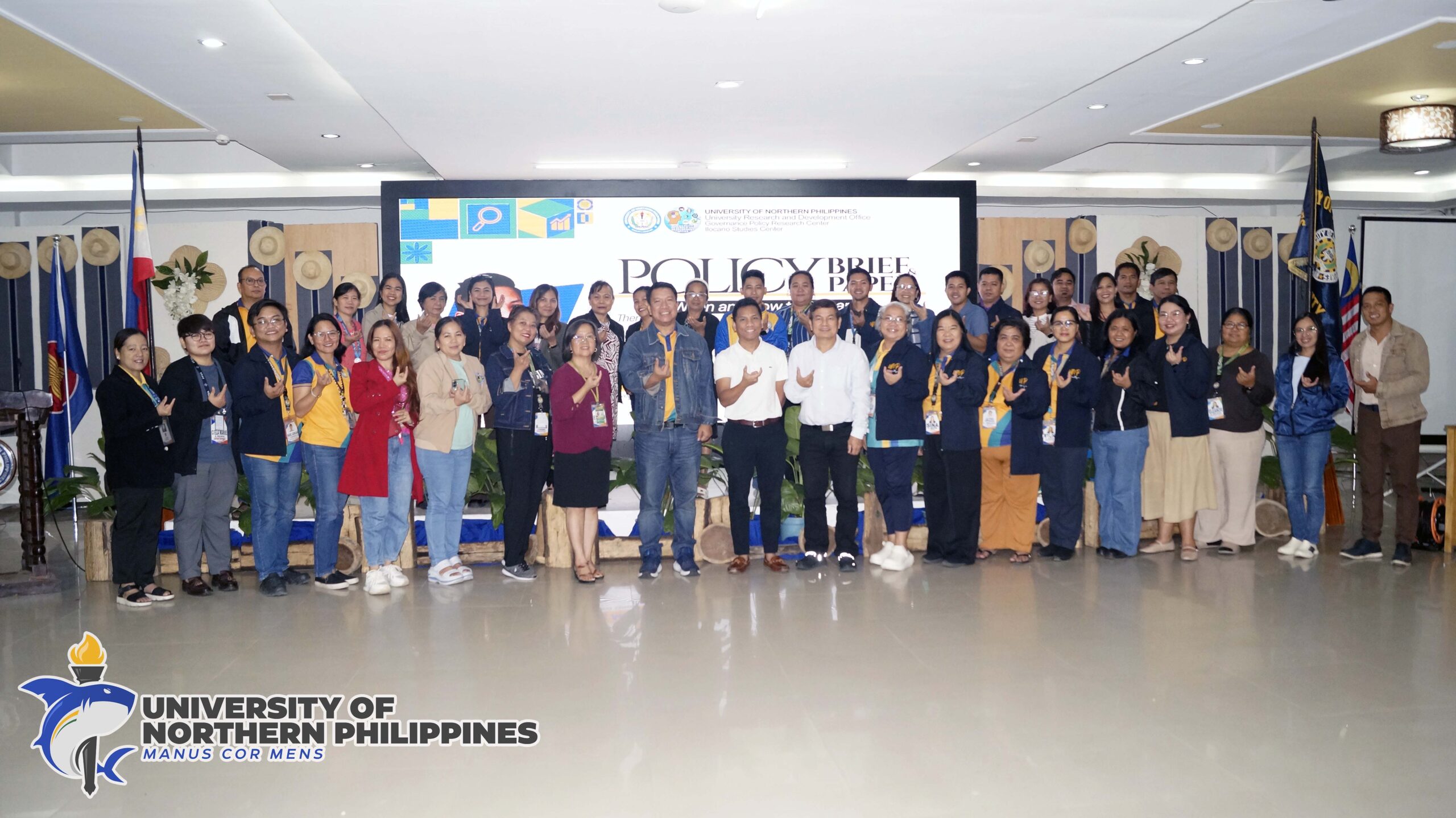
The University of Northern Philippines is strengthening the link between research and real-world decision-making through a two-day training on policy formulation held September 2–3, 2026, at the UNP Main Library and Tadena Hall.
The training emphasized UNP’s commitment to ensure that research does not end with academic presentation or publication, but translates into meaningful action. By equipping researchers with skills in developing evidence-based policy papers and briefs, the activity strengthened their capacity to distill complex research findings into concise, accessible, and actionable recommendations that can inform institutional decisions and address pressing public concerns.
Dubbed “Policy Paper and Policy Brief: When and How to Prepare?”, the training placed emphasis on strengthening researchers’ capacity to turn scholarly findings into policy instruments that can influence decisions and address emerging concerns. Carrying the theme “From Evidence to Action: Translating Research into Effective Policy Papers and Policy Briefs,” the activity highlighted the importance of presenting research evidence in a clear, focused, and policy-relevant format that decision-makers can readily understand and use.
Prof. Lesther Balmatero, senior lecturer at the University of the Philippines National College of Public Administration and Governance (UP NCPAG), served as resource speaker and expert partner, bringing public administration and governance perspectives into the training. His discussions guided participants in bridging the gap between academic evidence and the policy challenges confronting institutions and communities, emphasizing how research findings can be translated into practical, evidence-informed responses to issues requiring government and institutional action.
Prof. Balmatero opened the technical discussions by clarifying the distinct roles of policy papers and policy briefs in translating research into informed decision-making. He explained their differences in terms of length, target audience, level of analysis, and intended purpose, while guiding participants on when each format should be used to effectively communicate evidence and policy recommendations.
The participants were further challenged to look beyond the academic value of their studies and identify findings that could be elevated into concrete policy concerns. They examined the issues and their broader implications, identified the individuals, sectors, and institutions affected, evaluated the available evidence, and weighed the potential consequences of various policy options. This exercise strengthened their ability to view research not merely as a source of knowledge, but as a foundation for addressing real-world concerns and informing sound policy decisions.
Another key component of the training focused on translating research findings into actionable policy recommendations. Participants were encouraged to move beyond broad or generalized proposals and develop measures that are specific, feasible, evidence-based, and responsive to the actual conditions and needs identified in their studies.
The second day shifted the training from conceptual discussions to hands-on policy writing, as participants applied the principles they had learned in developing actual policy documents. After examining the essential structure and key elements of effective policy papers and briefs, the researchers drafted their own outputs under the guidance and technical mentoring of Prof. Balmatero, allowing them to directly translate their research findings into clear and policy-relevant recommendations.
The participants’ policy outputs underwent a peer review clinic, providing an opportunity to test the clarity, strength, and policy relevance of their work. Fellow researchers assessed the drafts, offering critical feedback on the articulation of the policy problem, the adequacy of supporting evidence, and the feasibility of the proposed actions. The participants then refined and finalized their outputs, with selected policy papers and briefs presented to the group for further discussion and learning.
UNP President Dr. Erwin Cadorna highlighted the vital role of sound policies in steering institutions toward informed and responsible decision-making. He emphasized that well-crafted policies provide the direction needed to ensure that decisions are grounded in evidence, responsive to prevailing concerns, and aligned with institutional and societal needs.
Vice President for Research and Extension Dr. Fatima Rocamora, meanwhile, stressed that effective policymaking must extend beyond formulation to implementation. She highlighted the importance of translating policies into concrete actions so that their intended outcomes can be realized and their benefits ultimately reach the communities and sectors they are designed to serve.
The training was spearheaded by the University Research and Development Office under the leadership of its Director, Dr. Edelyn A. Cadorna, reinforcing UNP’s commitment to maximizing the policy value and societal impact of academic research. The initiative was implemented through the Governance Policy Research Center, headed by Center Chief Dr. Florida U. Ursulom, which provided the institutional mechanism for advancing research-based policy development within the University.
The initiative reflects UNP’s continuing effort to position research as a driver of institutional improvement and community development, rather than an academic output confined to classrooms, conferences, or scholarly publications. By strengthening researchers’ policy-writing competencies, the University is creating a pathway for evidence-based studies to inform programs, enhance existing practices, guide decision-making, and contribute practical responses to pressing societal concerns.
The partnership with the University of the Philippines National College of Public Administration and Governance further strengthened the training’s governance dimension. Based at UP Diliman, UP NCPAG specializes in public administration and governance, with its work spanning education, research, professional training, policy advice, and technical assistance aimed at advancing public service and improving governance practice.